User Stories
User stories should be short simple narratives. Short means a few paragraphs.
They can represent a current situation, be of the As is, or can describe some ideal outcome, To be.
They can describe a current real world situation or be used to help explain how a new feature will be used.
In that sense they are very flexible. The important consideration is to make the reader aware of the context of the user story.
The figure below demonstrates how you can analyse your rich picture and identify the real people that make the whole system work. They are the candidates for your As is user stories. As part of the specification process for the CRM system, you should come back a re-write these stories, this time demonstrating the process improvements brought by the new CRM system i.e. state through stories how the CRM will be used and improve the situation.
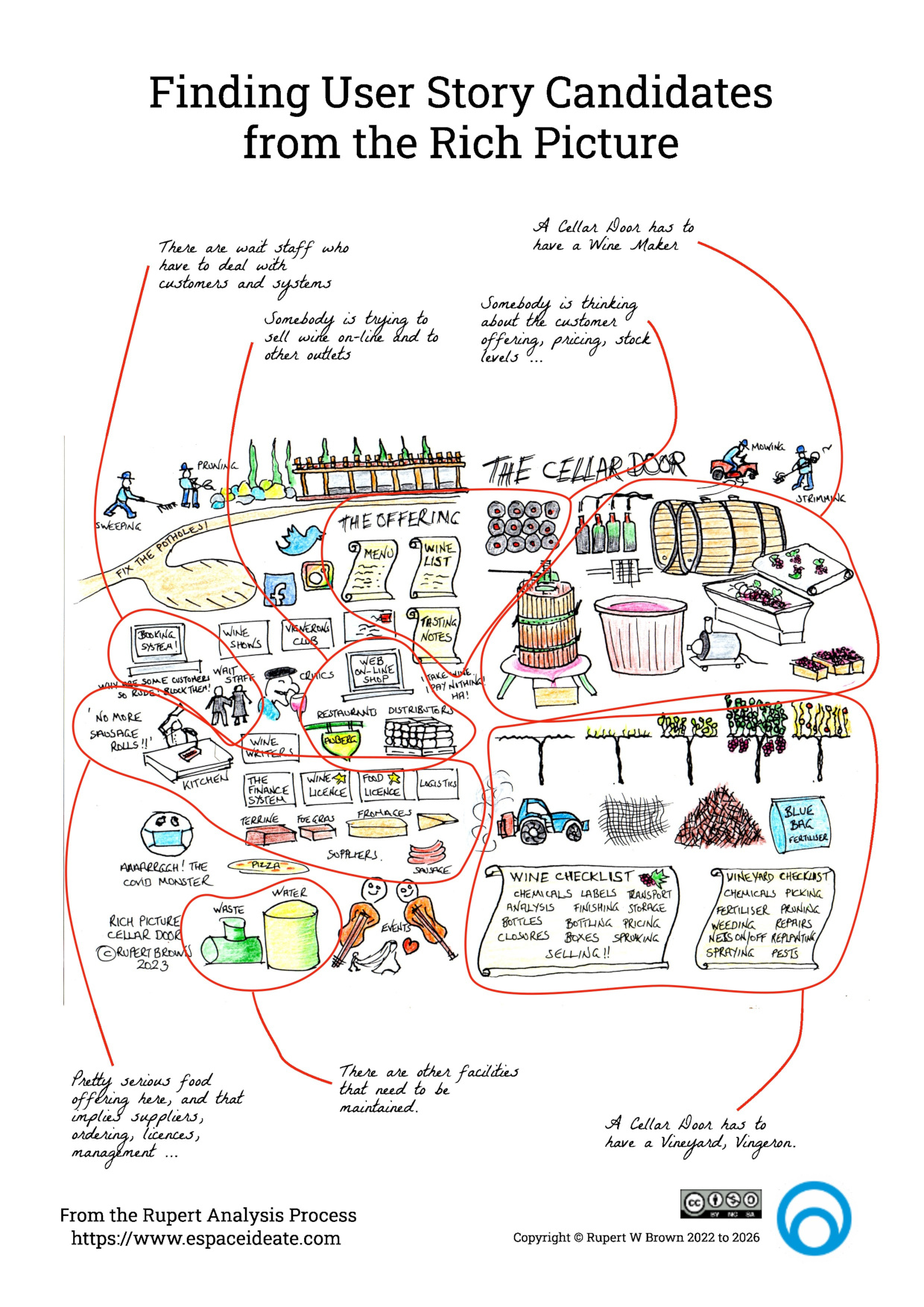
Finding User Story Candidates from the Rich Picture.
User Story examples
User Story - John plans to travel on a toll road
Context: This is describing how John would use a new toll road company website to work out what he has to do before he travels. This user story is written to explore how John might find the information he needs.
John and Ada live quite a long way out of the City and occasionally drive in to meet up with their daughter and have dinner. They stay at their favourite hotel which they both enjoy. John is a careful man who likes to plan. At 70 he has just mastered using the internet and spends several hours a day trawling through any number of sites.
He goes on to the local Department of Transport (DoT) website to check if there are to be any road works along his usual route. There aren't, but he notices a news story about the opening of the new toll road. He follows that link and realizes that he will be able to use the new road on his trip and it should save him time, but it also tells him he has to set up an "arrangement to pay", either buy a toll pass or open a tolling account. The DoT site provides a link to the toll road website.
John follows the link and lands on the website home page. The most obvious button for him is the "About to travel?" one, so he clicks on that. Reading the information he understands that an account works out cheaper per trip, but the "Types of accounts, passes" page indicates that setting up accounts requires paying some kind of deposit. He doesn't come into the City that much so in the end decides to buy two toll passes, one for the trip in, and one for the trip out the next morning.
He doesn't know what PayPal is. He'd much rather pay cash, but there is no option to do that. So reluctantly he gets the credit card off Ada and completes the transaction that way. He enters his e-mail address to ensure he gets a receipt. He always reconciles his credit card statement every month.
User Story - Jenny and Mary meeting up for lunch thanks to the Flag app
Context: This is describing how a new app called Flag can help people find each other in busy crowded places such as a food court.
Jenny and Mary work in the same office complex in the city. The complex has several huge office towers which are served by a large public space on the ground floor. This space contains all the lift lobbies, the complex reception area and a vast food court. Jenny and Mary both work hard and are very busy – so busy that lunch is usually a dash in the lift to the food court and then fifteen minutes of relative calm while they eat their lunch. They typically take their break at the same time, but never know quite where one or the other is going to be as they make their lunch selection from the large number of vendors in the food court.
In the past they've made efforts to call or instant message each other before they get in the lift, but with all the meetings they have to go to and the calls they have to make, that is rarely successful. More often than not they just forget.
So they've decided to try Flag. It's not a great loss to them if they don't meet up for any given lunch, but they would like to catch up if they are both in the food court at the same time. Jenny and Mary both download the app on their phones. They give the app "an identity" and then pair so that they'll recognise each other if they see each other in the food court. They choose the particular haptic pattern that their phones will use as an alert.
It's a Thursday and as usual Jenny is rushing around. 1 pm is fast approaching and she is feeling hungry. She navigates her way through the lift traffic and heads into the food court. She's thinking today she might try the sushi, so heads off to find the stall. On the way there she feels a gentle vibration from her phone. Looking round she spies Mary - who in turn is looking for her. They wave and then once lunch is secured meet up to spend time together.
User Story - The Cellar Door card index
Context: This is describing how the current Cellar Door manager has to work with an old card index.
"This Cellar Door is about fifty years old. It was started by Bernard and Sarah. It's about the oldest vineyard and winery in this region. We bought it from them a couple of years ago.
Over fifty years the Cellar Door has built up quite a following. We have many regular customers who buy wine from us every year. But fifty years ago there were no personal computers so Sarah wrote all the customer details and their orders down on index cards. Sarah has an encyclopedic knowledge of those cards which is really important because to an outside observer a lot of them just don't make sense.
There is one set of cards - fifteen in total - that are held together by an old paperclip. The name on the first card is "Man with spaniel" because that's how Sarah first identified this customer. It's not till we get to card three that Sarah actually found out his real name - Michael. The spaniel unfortunately is long dead. Michael still buys loads of wine.
Now I only know how all this works because Sarah gave me her card index and then comes in every week and helps me out. Without her it would have been a nightmare. Half of them don't seem to be active any more - probably because old age finally caught up with them. Moving forward we have to find a better way of using the information on the cards. There are only three hundred card sets, so not a huge number. It would be so good to have them on the computer so I could easily search them."